
Riesling has long been considered one of the classic white wine grapes. In today’s world, it struggles at times to hold its glass above the fray in the bright lights of wine trends (anyone for New Zealand Sauvignon Blanc?). Misconceptions abound with this grape too as there are some neophytes who assume that Riesling is sweet which is not the case unless it’s a late harvest. I call it Blue Nun/Black Tower trauma because when one is young and wine curious, it’s quite often one of the first Rieslings that people taste.
In one of the best places of the world for this noble grape to call home is Alsace – a cool climate that sees moderate amounts of rain with tall valleys & high slopes. Alsace is an in between place of sorts geographically as throughout its long history, it has changed hands at times between the French and Germans.
One of the oldest houses for Riesling is Domaine Schlumberger (1810) – the family is also the custodians of the largest number of Grand Cru vineyards in the region that total about 140 hA, an area of more than 5 kilometers along the Vosges River with altitudes that range between 250 to 390 metres in elevation. There are also a variety of soils which the family has carefully nurtured to makes Rieslings with very distinct characters.
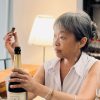
A masterclass with Severine Schlumberger, who took over from her father Eric upon his retirement in 2001, was most enlightening – it was a tasting that compared terroirs and vintages. Almost all of Severine’s wines are fermented in 100+ years old oak cask – an ultimate goal in being frugal with casks and very environmentally friendly.

We begin with Severine’s Les Princes Abbes 2021 Riesling – a wine which she calls her everyday Riesling that is available at a reasonable price point (under HK$200). Despite this being her everyday wine, 30% of the grapes in this are from her Grand Cru vineyards. This was, of course, not sweet but very dry and crisp with a bright acidity. Severine’s firm belief is, “one should judge a winemaker by what he/she can do with an everyday wine” and not by their best wine because when one is making a top wine, of course, all bets are off as one can put in all efforts and technical backups/equipment to give that wine every opportunity to shine. An everyday wine needs dedication and skill to make the grapes for that wine to show its best with the tools at hand.
We focussed on 2 of her best Grand Crus with distinct terroirs (from my notes):
Kitterle Grand Cru
Volcanic: 26 hA, of which 20 belong to Schlumberger – steep slopes that are reinforced with stone walls, all of which have been shaped by hand over the years; altitude ranges from 270 to 360 meters. It retains the heat of the sun well but the soils are poor and sandy, thus forcing the roots to go far down to seek moisture and to hold itself up.
Saering Grand Cru
Limestone – 27 hA, 20 of which belong to Schlumberger – millenias ago, the Rhine Valley was under the sea and today, these limestone soils make wines with distinctive iodine notes & that crispy tang Riesling afficionadoes love and recognise. Saering is also known as ‘Ring of the Sea’ – there are 27 hA, 20 of which belong to Schlumberger. Limestone is the most prevalent soil base for the Rhine Valley.
2014 Vintage
A mild winter followed by a very warm spring (early budbreak) and hot summer but fortunately August was cool.
Saering Grand Cru – the grapes were picked late, residual sugar came to about 9 g/L, which resulted in a wine that was deliciously off-dry (I had to think twice if it was dry or off-dry). Very minerally, with a hint of salinity on the finish.
Kitterle Grand Cru – this was refreshingly crisp with almost crunchy green apple notes, residual sugar about 5 g/L. A long tangy finish on the palate
2007 Vintage
Weather conditions similar to that of 2014 for winter and spring. Summer was marked with many rainy periods followed by cool weather which resulted in slow ripening of the grapes.
Saering Grand Cru – multihued citrus notes with just a hint of oxidation (a sign of age) on the nose, this still showed much life with its long lemony finish; residual sugar was about 9 g/L (grapes picked after Kitterle) but wine was very dry on the palate.
Kitterle Grand Cru – very much freshly squeezed citrus on the palate and noses, this was incredibly fresh with a lengthy zesty finish; residual sugar 5 g/L
Schluberger’s best site for Riesling is considered Le Clos Saint Leger which is named after Saint Leger Church (part of Murbach Abbey) which was built in the 11th century, a monk named Frulandus wrote in ‘Life of Saint Leger’ that Florival in the Guebwiller Valley is ‘a blessed valley, like a celestial jewel, in which the blood of the vine flows in torrents’. From this inspiration, the Schlumberger family found and named a single plot that grew exceptional Riesling in Kitterle Grand Cru as Le Clos Saint Leger. This plot is particularly vertiginous (steep) at 342 to 392 meters, thus requiring that everything is done painstakingly by hand. Yields are low, with the grapes picked at dawn and then carried down to the winery to be sorted and slow pressed. It is fermented in stainless steel, not 100 year old oak barrels and stored on its lees before bottling.


2017 Le Clos Saint Leger
In the glass, this was magnificent – the nose was most enticing with its tangy aromas of slightly spiced apples, white flowers and lime leaf; residual sugar about 0.5 g/L. Finish was long, with a hint of sea salt & lemon zest. Still young, it would be most interesting to have an opportunity to try this again in a few years.
Severine brought along a very special bottle from her family’s cellars – a 1945 Riesling from Kitterle Grand Cru (although sadly the label was long gone), she assured that the family had had this vineyard for almost 100 years. What was most interesting about this vintage was that the year, 1945 – WWII was still raging through Europe and people were just doing their best to survive and stay safe. The vines on this vineyard received no attention at all as the Germans had taken over the Alsace region. The war ended on the 6th of August in the area. Life slowly started to come back to normal as people started to return to their homes. This vintage was mostly picked by the wives, children and grandparents as many of the men were still enlisted and on duty with the army. Despite the fact that the vines received absolutely no attention until harvest, it begs the question of who made this – Mother Nature or man?
A sip of this made me realize that in the face of all hardships and against all odds, a wine was made to celebrate that life goes on. It was the colour of a light tea, the acidity was still there with its classic Riesling flavours of citrus and apple (although a bit muted in its age). The finish was very long, and I certainly hope that Severine has a few more bottles of this to share on a future visit to Hong Kong.


Discover more from Vino Joy News
Subscribe to get the latest posts sent to your email.


